

Major Tax Law Change: How the 2025 Legislation Is Driving the 2026 Tax Rules

The 2026 tax season is being shaped by one of the most important legislative updates in recent years. A significant law passed in 2025—commonly referred to as the One Big Beautiful Bill Act—introduced adjustments that are now influencing how taxpayers file in 2026 and how they will plan for future tax years.
While many expected sweeping, disruptive reforms, the legislation instead focused on stabilizing the tax system. Rather than creating a dramatic overhaul, it extended and reinforced many provisions from earlier tax reforms, giving taxpayers and businesses a clearer path forward.
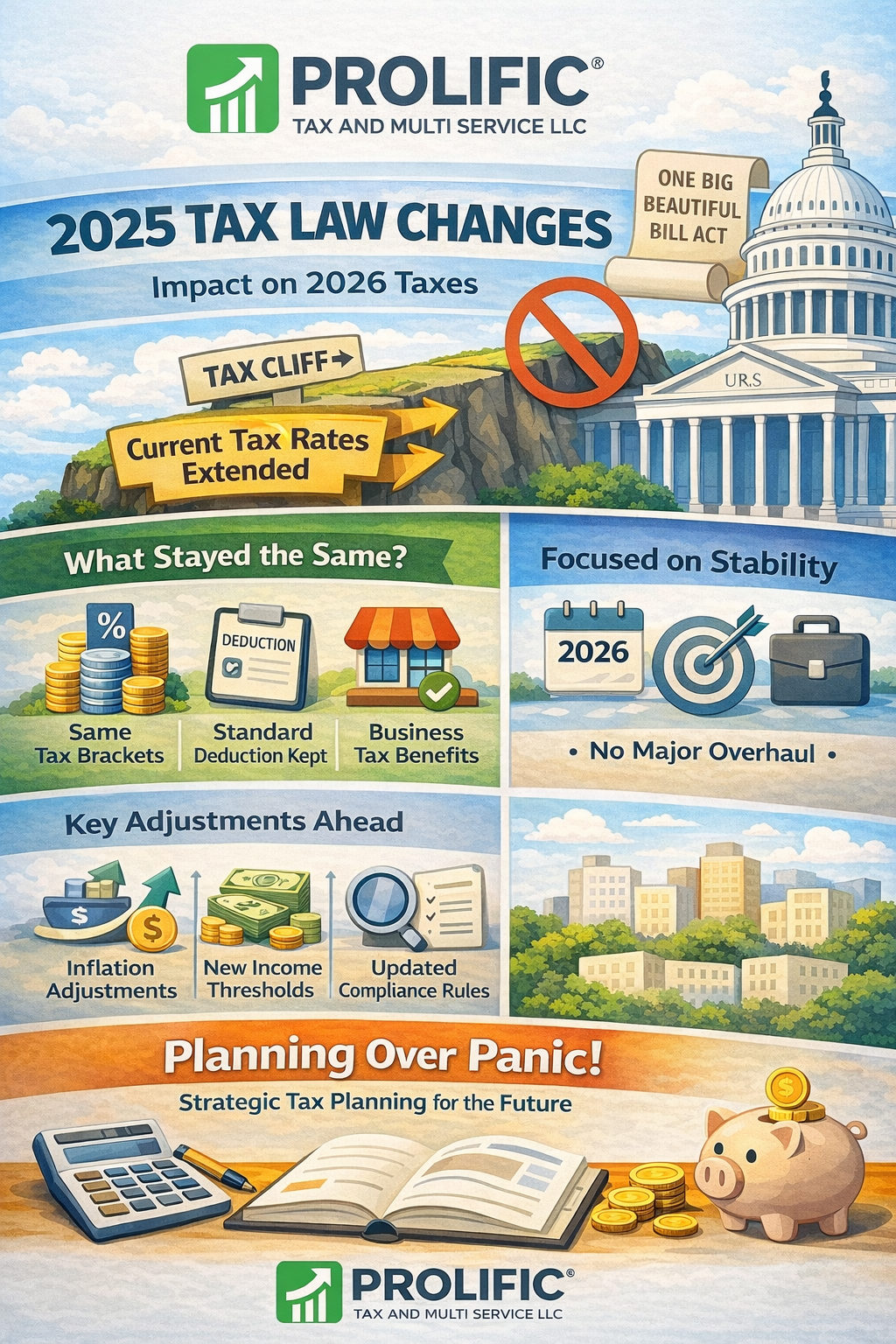
Why This Law Matters Now
For the past several years, tax professionals warned about the possibility of a “tax cliff.” This scenario would have occurred if key provisions from prior reforms expired, causing:
- Higher individual tax rates
- Reduced standard deductions
- Changes to business tax treatment
- A return to older, less favorable rules
The 2025 legislation largely prevented that outcome by extending many of those provisions and, in some cases, making them permanent. As a result, the structure taxpayers have been working under remains largely intact.
In simple terms:
The feared tax cliff did not happen. The current rate structure and many familiar rules are continuing.
Stability Over Sudden Change
Instead of introducing entirely new tax systems, lawmakers chose to prioritize continuity. This approach provides predictability for:
- Individual taxpayers managing income and deductions
- Business owners making operational and entity decisions
- Financial planners structuring long-term strategies
This stability is especially important for small businesses and self-employed individuals who rely on consistent tax treatment when forecasting expenses, hiring employees, or expanding operations.
What Stayed the Same
Because many provisions were extended, taxpayers will notice that:
- The familiar tax bracket system remains in place.
- Standard deduction levels continue to be a central benefit.
- Pass-through entities (such as LLCs and S-Corps) still retain key advantages.
- Existing deductions and credits remain part of tax planning strategies.
This continuity allows taxpayers to plan with more confidence rather than reacting to sudden rule changes.
What Actually Changed
Although the structure remains familiar, the legislation still drives important adjustments, particularly when combined with annual inflation updates and administrative modernization. These updates influence:
- Income thresholds tied to tax brackets
- Deduction amounts adjusted for cost of living
- Compliance and reporting expectations
- Long-term planning opportunities rather than short-term relief
In other words, the law reshapes how taxes are applied over time rather than rewriting the system overnight.
A Shift Toward Strategic Tax Planning
Because the legislation reinforces existing frameworks instead of introducing new temporary breaks, tax savings now depend more on proactive planning than on new credits or stimulus-style benefits.
This environment rewards taxpayers who:
- Review their entity structure regularly
- Maintain accurate bookkeeping throughout the year
- Align compensation, deductions, and investments with tax strategy
- Seek advisory guidance instead of relying solely on year-end filing
The focus is moving away from reactive tax preparation and toward year-round tax management.
Looking Ahead
The 2025 legislation signals a broader direction for the U.S. tax system—one centered on permanence, predictability, and gradual modernization. Rather than facing sudden legislative swings, taxpayers can expect incremental adjustments layered onto a stable framework.
For individuals and businesses alike, this means the opportunity to plan with greater certainty while adapting to evolving administrative and economic conditions.
Final Takeaway
The biggest impact of the 2025 tax law is not dramatic change—it is the continuation of the current system. By preventing a rollback to pre-2017 rules, the legislation preserved today’s tax structure and provided a foundation for long-term planning.
Translation: The tax cliff never arrived.
Instead, taxpayers now operate in a more stable environment where smart planning—not sudden law changes—will determine the greatest tax advantages.